
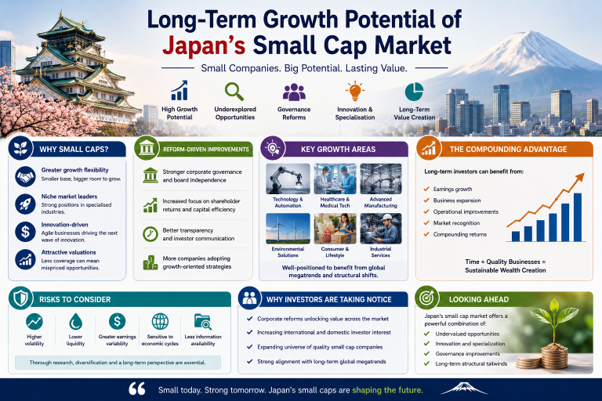

Japan is home to one of the world’s largest and most sophisticated equity markets. While global investors often focus on the country’s major multinational corporations, increasing attention is being directed toward Japan’s small cap segment. These smaller companies frequently operate in specialised industries, serve niche markets, and possess significant growth potential that may not yet be fully recognised by the broader investment community.
The growing popularity of Japan small cap equity funds reflects a rising interest in uncovering opportunities beyond the country’s large-cap stocks. Investors are increasingly exploring businesses that have the potential to expand earnings, improve operational efficiency, and generate substantial shareholder value over the long term.
A disciplined stock selection process is particularly important in the small cap universe because these companies often receive less analyst coverage and may be less familiar to international investors. Careful research can uncover businesses with strong fundamentals, competitive advantages, and attractive growth prospects.
Understanding Japan’s Small Cap Market
Small cap companies are generally businesses with smaller market capitalisations compared to large multinational corporations. Despite their size, many of these firms play critical roles within Japan’s economy and industrial ecosystem.
Japan’s small cap universe includes companies operating across a wide range of industries, including:
- Technology
- Manufacturing
- Healthcare
- Consumer products
- Industrial services
- Environmental solutions
Many of these businesses are market leaders within specialised niches, even if they are relatively unknown outside Japan.
Unlike large corporations that often face slower growth due to their scale, smaller companies may have greater flexibility to innovate, expand, and adapt to changing market conditions.
This dynamic creates opportunities for investors willing to look beyond widely followed stocks.
Higher Growth Potential Compared to Large Caps
One of the primary attractions of small cap investing is the potential for higher growth.
Because smaller companies are often earlier in their development cycles, they may have greater opportunities to increase revenues, expand market share, and improve profitability.
Several factors contribute to this potential:
- Expanding customer bases
- New product development
- Geographic expansion
- Industry disruption
- Operational improvements
A company generating annual revenue of a few hundred million dollars may find it easier to double its business than a multinational corporation already generating tens of billions in revenue.
While higher growth is never guaranteed, the opportunity for significant business expansion often attracts long-term investors to the small cap segment.
Opportunities Created by Limited Market Coverage
Many Japanese small cap companies receive significantly less attention from analysts and institutional investors than larger corporations.
This lower visibility can create opportunities for investors who conduct thorough research.
Benefits of limited market coverage may include:
- Mispriced securities
- Undervalued growth opportunities
- Delayed market recognition
- Less competition among investors
In highly researched markets, attractive investment opportunities are often identified quickly. In contrast, smaller companies may remain overlooked for extended periods.
A business with strong financial performance and competitive advantages may trade below its intrinsic value simply because it receives limited investor attention. For active investors, this information gap can create opportunities to identify promising businesses before they become widely recognised.
Corporate Governance Improvements Supporting Growth
Corporate governance reforms have played an important role in improving the attractiveness of Japanese equities, including small cap companies.
Over the past decade, many Japanese businesses have become more focused on:
- Shareholder returns
- Capital efficiency
- Transparency
- Board independence
- Strategic growth initiatives
These changes have encouraged management teams to prioritise value creation and improve communication with investors. As governance standards continue to strengthen, smaller companies may benefit from increased investor confidence and greater access to capital.
Improved governance also helps attract international investors who previously viewed certain segments of the Japanese market as difficult to evaluate. This evolving corporate environment supports the long-term development of the small cap sector.
Innovation and Niche Market Leadership
Many Japanese small cap companies operate in highly specialised industries where they possess unique expertise and competitive advantages.
Japan has a long history of technological innovation and manufacturing excellence. Numerous smaller businesses contribute to global supply chains by producing specialised components, advanced materials, and precision technologies.
Examples of growth areas include:
- Robotics
- Automation
- Medical technology
- Semiconductor equipment
- Environmental solutions
- Advanced manufacturing
Some of these companies hold dominant positions within niche markets despite having relatively modest market capitalisations. As global demand for innovation continues to increase, these specialised businesses may benefit from long-term structural growth trends.
Their ability to compete globally often enhances their attractiveness as investment opportunities.
The Role of Economic and Structural Trends
Several long-term trends may support the growth of Japan’s small cap market in the years ahead.
These include:
- Digital transformation
- Automation adoption
- Healthcare innovation
- Sustainability initiatives
- Productivity improvements
- Supply chain modernisation
Many smaller companies are well-positioned to provide products and services that address these evolving needs. For example, Japan’s aging population has increased demand for healthcare technologies and efficiency-enhancing solutions. Small cap companies operating within these sectors may benefit from long-term demand growth.
Similarly, global efforts to improve manufacturing efficiency continue to create opportunities for businesses specialising in automation and industrial technology. These structural trends provide a supportive backdrop for future growth.
Risks Investors Should Consider
While the growth potential of small cap stocks can be attractive, investors should also recognise the associated risks.
Small cap investments often experience:
- Higher price volatility
- Lower liquidity
- Greater earnings variability
- Increased sensitivity to economic conditions
Smaller companies may have fewer financial resources and may be more vulnerable during economic downturns. In addition, information availability may be more limited compared to larger corporations, making research and due diligence especially important.
Successful small cap investing often requires a long-term perspective and a willingness to tolerate periods of market volatility. Investors should carefully evaluate risk tolerance and diversification needs before allocating significant capital to this segment.
Why Long-Term Investors Are Interested
Many investors are attracted to Japan’s small cap market because of its long-term value creation potential.
Long-term investing allows shareholders to benefit from:
- Business expansion
- Earnings growth
- Operational improvements
- Market recognition
- Compounding returns
The combination of innovation, governance reforms, attractive valuations, and structural growth opportunities has strengthened the case for long-term exposure to the sector.
Investors who identify strong businesses early and maintain patience may benefit as these companies mature and attract broader investor attention.
The small cap market often rewards those willing to focus on long-term fundamentals rather than short-term market fluctuations.
Conclusion
Japan’s small cap market represents a compelling area of opportunity for investors seeking long-term growth potential. While large Japanese corporations continue to play an important role in global markets, many smaller businesses offer unique advantages through innovation, niche market leadership, and the ability to grow more rapidly from a smaller base.
Improving corporate governance, increasing shareholder focus, and favourable structural trends further enhance the attractiveness of the sector. Additionally, limited analyst coverage and market inefficiencies may create opportunities for investors willing to conduct thorough research.
Although small cap investing involves higher risks and volatility, the potential rewards can be significant for those with a long-term investment horizon. As Japan’s economy and corporate landscape continue to evolve, the country’s small cap segment may remain an important source of growth and value creation for years to come.